Solidarity Fund Celebrates First Delivery

Solidarity Fund Celebrates First Delivery

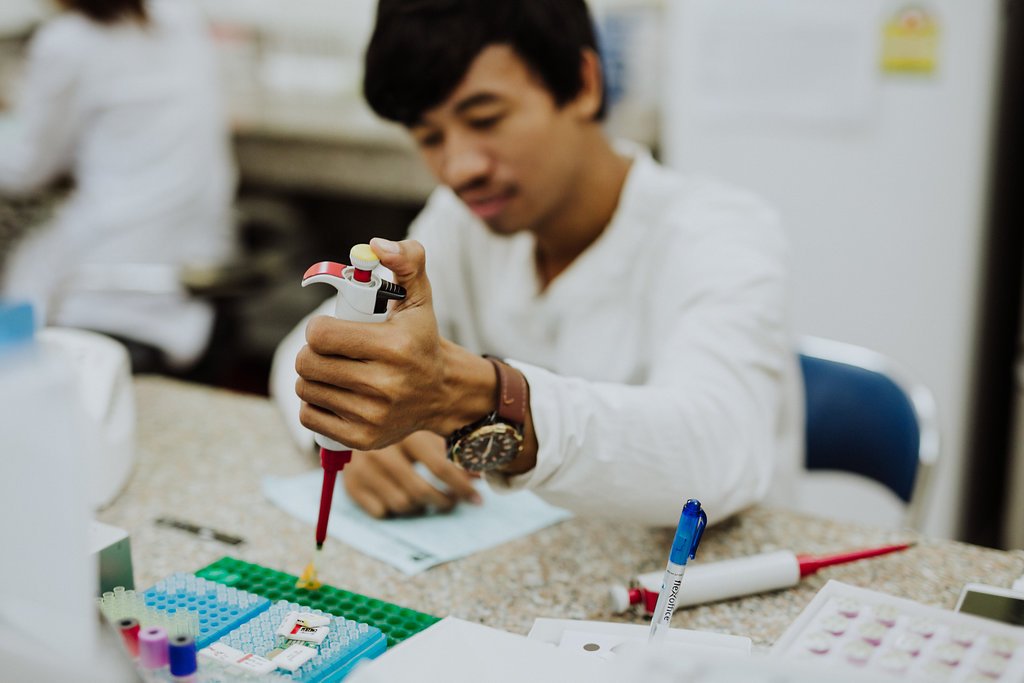
Earlier this month, The Max Foundation celebrated the delivery of 110 BCR-ABL molecular tests to Mercy Medical Center Cambodia. The delivery was the first of its kind for Max, made possible through our 2018 Diagnostics Solidarity Fund. Two more deliveries – one to Kyrgyzstan and one to Bolivia – are in process now, and we’re hopeful there will be many more to come.

Why are BCR-ABL molecular tests important?

Before a patient can be treated, he or she must first be diagnosed. A simple concept to be sure, but with a disease like chronic myeloid leukemia (CML), diagnosis isn’t that simple.

In order to accurately diagnose CML and monitor a patient’s ongoing treatment, molecular testing is required to determine the presence and prevalence of the mutated BCR-ABL protein. However, in the low- and middle-income countries where we work, molecular testing is often unavailable or prohibitively expensive.

Bridging Gaps in Access

To help bridge that gap for patients, we established the 2018 Diagnostics Solidarity Fund – a donation program dedicated to increasing access to molecular testing in 22 resource-challenged countries. Specifically, the fund enables The Max Foundation to donate up to 3,600 BCR-ABL molecular tests to qualifying institutions.

Each one of the 110 tests delivered to Mercy Medical Center Cambodia represents an opportunity – either for a new patient to gain access to life-saving treatment, or, for an existing patient to improve his or her disease outcome. Those are opportunities worth celebrating.

Special Thanks

We offer our heartfelt thanks and appreciation to the CML/GIST team at Mercy Medical Cambodia: Drs. Tim Benadum, Mary Kluck, Inge Mathes, and Alan Norman, as well as head administrator Sovatdy Sanh, and laboratory technicians Kanhara Im and Saora Toeur (pictured). They go above and beyond for their patients each and every day and it’s an honor to support their efforts.

The Max Foundation is a leading global health nonprofit organization dedicated to accelerating health equity. For 28 years, Max has pioneered practical, scalable, high-quality solutions to bring life-extending treatments and patient-centered health care to more than 100,000 people living with cancer and critical illness in low- and middle-income countries. Max believes in a world where all people can access high-impact medicines, where geography is not destiny, and where everyone can strive for health with dignity and with hope.

Related Articles

  • Welcoming Dr. Michael J. Wagner, MD, to The Max Foundation’s Medical Advisory Board

    Welcoming Dr. Michael J. Wagner, MD, to The Max Foundation’s Medical Advisory Board

    The Max Foundation is thrilled to welcome Dr. Michael J. Wagner to our Gastrointestinal Stromal Tumor (GIST) Medical Advisory Board. Since we met Dr. Wagner in early 2020 at a GIST patient meeting in Seattle, he has provided our program with invaluable training and support. “Dr. Wagner has gone above and beyond in advising our….

  • Pat Garcia-Gonzalez joins shortlist of nominees for UICC’s Outstanding Contribution to Cancer Control Award

    Pat Garcia-Gonzalez joins shortlist of nominees for UICC’s Outstanding Contribution to Cancer Control Award

    Pat joins Paul Farmer, President Joe Biden, and other world leaders in “Driving innovation to advance cancer control equitably”

  • The Max Foundation Establishes Unprecedented Network of Leading Cancer Providers in LMIC

    The Max Foundation Establishes Unprecedented Network of Leading Cancer Providers in LMIC

    In an effort to strengthen health outcomes for patients in low resource settings, The Max Foundation and its subsidiary, MaxAid, have signed Collaboration Agreements with 140 individual hematologists and oncologists from leading National Cancer Institutes and clinics in 60 low and middle income countries. With the formal establishment of this network, The Max Foundation completes its validated supply chain into each of the countries, providing a safe environment through which to channel humanitarian donations of cancer treatment with end-to-end controls.